Main

Everybody's Business - Public Corporate and Government - as appropriate Archives

May 15, 1984

Business Education and Social Responsibility

In the spring of 1984 I drafted a proposal for 'alternative' business education at my school, Hampshire College. This followed up on my earlier work in the field of Socially Responsible Investing - something documented in the Hampshire College archives.

Though some of the radical folks hated me I did establish good relationships with a few board members - I have a great story about hanging out with the IBM R&D V.P. and also met Secretary of Transportation Brock Adams. But my best working relationship was with a gentleman by the name of Yerger Johnstone, a Vietnam era colonel and managing director of Venture Capital for Morgan Stanley. (He married a woman of more left leaning persuasions, assumably for love.)

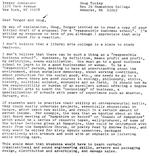
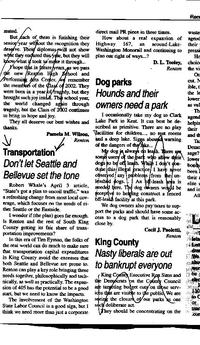
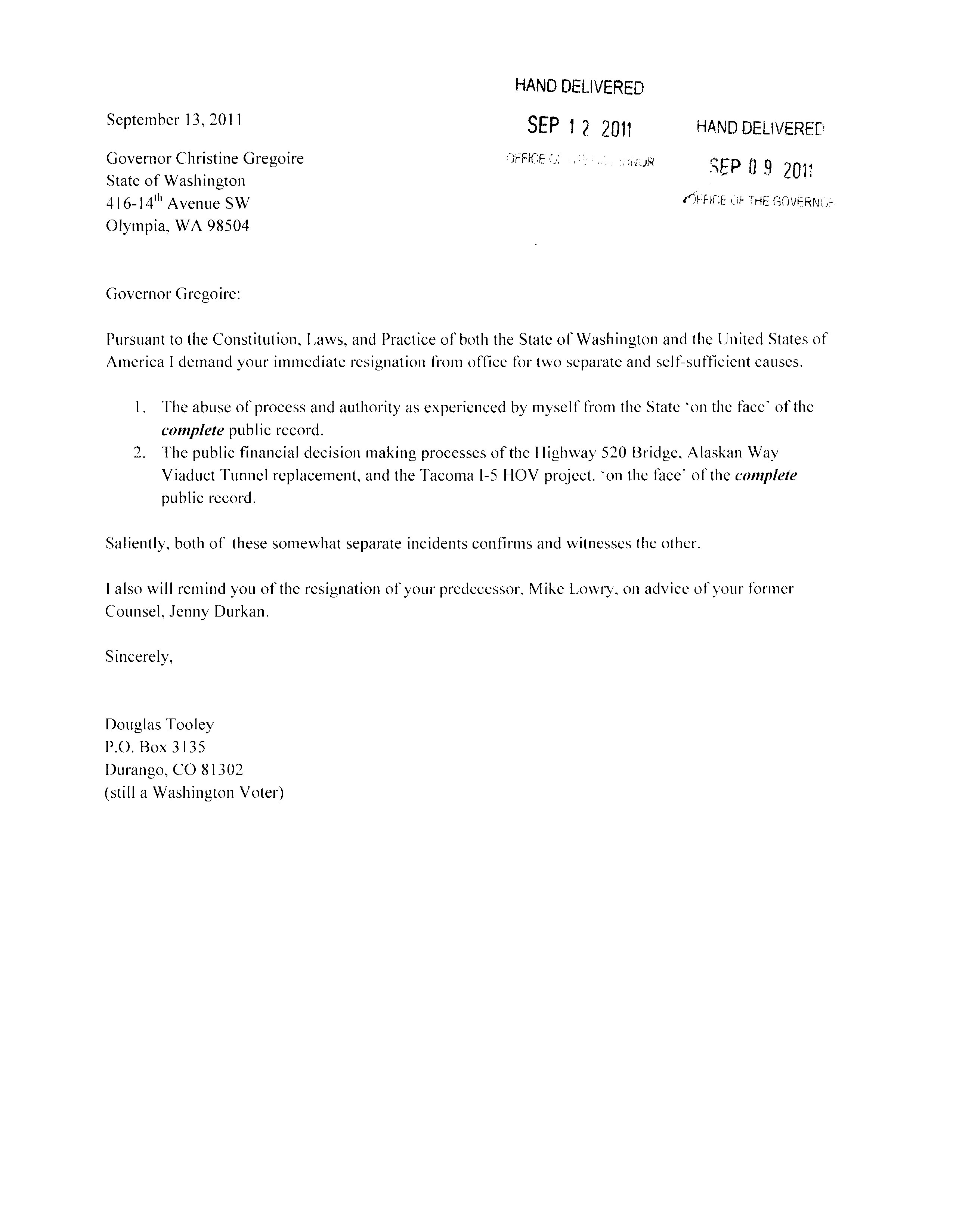
The below letter is from another Board Member, the respected NY Nuclear Activist Cora Weiss, concerning a forward of that proposal from Yerger.


View image


Unfortunately this is an idea I didn't follow up on - lost over the summer, and the following year. Ms. Weiss's points are accurate - including competition from the Yale School of Management not too far South. Her points about individuals managing their own work do highlite an important distinction about just what actually constitutes 'business'.

Her definition of business as exploitation is unfortunately too close to the truth. My belief though is that business in a democracy is not based on corporate units but rather individuals making decisions on how to best apply their time to their own 'life, liberty, and the pursuit of happiness'.

October 22, 1987

Portrait of the Blogger as a Young Blowhard

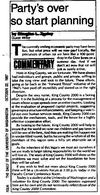
I moved to Seattle in January 1986, my first civic involvement was volunteering to help start the Broadway (Seattle) BIA, second was a group called KC 2000. (The end result would be the Metro/King County Merger per the Judge Zilly decision.) These folks would be perceived as the typical regional heavy hitter crowd. FWIW though the earlier, more modest endeavor, sits sweeter in my memory.

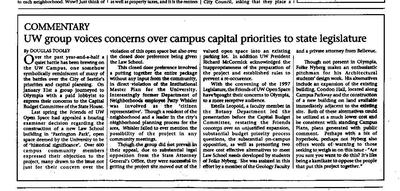
This was the end of the Reagan, fall of 1987 when George I was making his run. At that time the economy was tanking, and I used that as a theme for a promotional editorial I wrote in the UW Student Newspaper - The Daily.

Best thing about this event was the UW Students and Faculty I met - faculty included the Geographer/Demographer Richard Morrill and Transportation Engineer Scott Rutherford.

Two student footnotes: The Op-Ed was published by Sally Clark, currently a Seattle Councilmember, and perhaps the best home grown public career resume of my generation, locally.

Asterisk
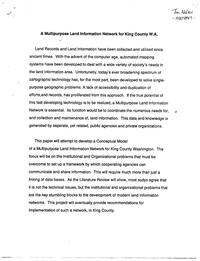
Second was Tom Nolan. At the time he was doing his Master's Thesis on a proposed Computerized Mapping system for King County. Tom currently runs the City of Seattle Department, funded by City Light. This is his Master's thesis abstract/outline relevant to the local history of this profession, a topic I should continue to write on.

The handwriting should be his.

July 6, 1994

District Elections

This isn't so much a biographical item as an interesting story which I was a somewhat close spectator of.

District elections would play out as a major scandal. Though not conceived as an attack on the Seattle establishment, it was certainly an effort to make electability more accessible to the average citizen. Kerman Kermoade, the author of the following was a friend on the Vision board, doing this as a project for his later life Poly Sci degree. I was at the initial organizing meetings.

As you may recall this became a scandal when it was revealed that food executive (and active Republican) Tom Stewart was making illegal contributions as a way to seek revenge for previous battles with the City bureaucracy. I wasn't active in the campaign and know nothing about the details of Stewart's other battles. Stewart, with his company, has since left the State, one of several biggies in the last decade or so.

Tacoma, as you may know, has a mixed system of at-large and district seats - the particular mix I came to favor out of observing these debates.

May 15, 2002

Renton Reporter Letter on Transportation

As a resident of Tacoma I'd make a similar argument for Pierce County. Perhaps the most important thing to think about is how Pierce and S. King coordinate their somewhat overlapping interests.

October 17, 2007

Everybody's a Transit Expert

I've always liked Danny Westneat, but his latest has me wondering as he proclaims to be a better financial analyst than Brian Sonntag evaluating Sound Transit.

There are two things we know for sure about Sound Transit - that we haven't seen any of the SeaTac-Dowtown line work, so we have NO BASELINE to realistically compare it to anything - and that Transit finance numbers are always underestimated dramatically. It is quite safe to say that this is not a ten billlion dollar project.

We also know that the last three votes to expand Portland 's Max system have failed.

I know, and you should too, that we can do much better. No doubt 'they' are already making excuses about why this project failed because of the 'public', not because the plan, or 'they', are losers.

I'm not anti-light rail - but we need to insist we do it right - and if 'they' refuse - as is evidenced here - 'they' need to be fired for insubordination- or for soliciting a fraud, to be more specific. The only line that even merits discussion for expansion at this point is the Tacoma line - and that only modestly. Fairly, I guess it would also make sense to seek funds to fulfill the original promise made to voters - the dropped stations and the U-District leg. Along that line a starter system in Everett and Bellevue would also make sense. Bellevue might well choose a bus tunnel though - following the already established investment phasing plan of the Seattle Hybrid Tunnel. That would be a smart continuation of the best of the Status Quo, not the worst - rewarding those project ideas, and people, that have earned it, yes?

BTW - on the subject of global warming - how about spending your own money, wisely, to buy an electric vehicle? Or for that matter, take the money you save from riding the bus and invest it in a green investment fund?

Heyo!

October 29, 2007

The Media is the Message

A thumb's up for a new local online publication, Crosscut.

Publisher David Brewster is certainly already a member of the local establishment elite, but this is a publication that could shake things up - perhaps continuing his contributing record of societal progress through two generations, not just one.

A good case in point has been their excellent coverage of local transportation issues. Currently the most popular article is a piece by former UW Geographer/Demographer Professor Richard Morrill. (Disclosure - I studied under Dr. Morrill at the UW - this reference though is not so nepotistic as it might seem, but that is a longer story.) Besides Dr. Morrill, Emory Bundy, another local civic legend, has also contributed, as has Brewster himself. The topic in its entirety is referenced in a sidebar.

If you wish to educate yourself on these subjects there is probably no better an investment of time than that spent here. Perhaps most significant is the quality of the comments. Actual debate occurs - going into subjects honestly that are perhaps to sensitive for a prudent professional. An occassional raver will show up, but it is the exception, not the rule.

Among those contributors is David Sucher. Mr. Sucher is a published author himself, as well as a bit of a role model, por moi. I'd highly recommend his accessible and useful book 'City Comforts', now in its second printing. Urban Planning is a somewhat mysterious subject, but Sucher gets his hands on it - not to mention living his life, and business, by some of its principles.

October 31, 2007

Following the Money, Energetically

The recently announced sale of Puget Energy struck me as curious - this is a major business event. The brevity, finality, and timing of this action all have drawn my attention.

There isn't much published detail out there - the proclaimed motivations about the need for capital may well be a factor, but these aren't folks with bad credit and they certainly aren't anywhere near bankruptcy. Their five and ten year stock performance is solid, slightly above the benchmark performance of the S&P 500, but significantly below that of other utility stocks.

PSE is highly regulated by the State Utilities and Transportation Commission - and their return is subject to law - their financials, to me, indicate a fair and effective regulatory environment - beating the S&P by 1% is certainly a good return and one not usurious, as other private utilities, in this era of Enron, may have been able to obtain. The sale will not effect this at all - it will however remove the SEC from the regulatory loop - which presumably has some relationships with local regulatory agencies.

The current chairmanship of the UTC by former Seattle City Attorney Mark Sidran is perhaps the most factually based red flag of this deal. Mark Sidran has been involved in other highly controversial public/private deals with Puget Energy legal representatives(Preston, Gates, and Ellis) - most notably the HUD distressed area financing for a downtown parking garage in an upscale shopping district.

As a blogger I am hopefully allowed a bit more room to speculate - using the motley tools of Occam's Razor (aka Keep It Simple Stupid) and my personal favorite, 'Follow the Money'.

My original thought was that this was some sort of global energy deal taking Enron's practices worldwide - perhaps with Chinese Money. Perhaps also part of the 'hedging' going on with Halliburton style engineering contracts now being considered as a part of a current proposal by another Preston, Gates, Ellis client - a potentially 157 billion 50 year deal to build light rail, and some roads based on local taxing/bonding authority.

Like me, the Wall Street Journal has published some investigative speculations into this matter. This got me to thinking about motivations of intra-family politics as opposed to global - and these factors may well be in the mix. The iconic former Puget Energy President, John Ellis, has a brother, Jim. Jim was, at the height of his game, legal counsel for Puget Energy, and perhaps the single most powerful attorney in private practice - he is the Ellis in Preston, Gates, and Ellis.

That position of status is now held by the firm's prior family law specialist, Bill Gates Sr. Microsoft is also within the firm's stable, and one has to wonder if there is perhaps some aspect of global dealings in order to build relationships that will help them stand up against the heavy oversight they are now getting in Europe. There may well also be some standing anonomosity whereas Gates was once subordinate to Ellis. Now, I'm not one to say that nepotistic legal representation should be outlawed by the SEC, but it is certainly an area worthy of investigation and a heuristic red flag for any regulator. I'd suggest looking into the relationship between Microsoft and another globally merged PGE Client, Airborne Express. Airborne (now owned by the state Monopoly, Deutsche Post and operating as DHL) held the MS air courier contract - a contract that may not have been in the best interests of MS shareholders (and certainly quite lucrative to Airborne).

I did some digging into this subject in order to quench my curiousity. Puget Energy's own statement reveals little, save perhaps the shallowness of press coverage. State Attorney General Rob McKenna's Public Counsel (a pfellow with a pfunny name, Simon ffitch) has released a statement which outlines future steps as I've done above.

Conclusion - it is not a done deal, it is still subject to regulatory and shareholder approval. Absent a more informed shareholder making claims to the contrary I will accept the assertions of Puget Energy Corporate that both steps are likely to be accomplished.

Continuing my research I looked into the lead partner, Macquarie Infrastructure. Macquarie is one of the few Investment Banks in Australia and are traded on the NYSE - stock symbol MIC. There holdings include a recently completed deal to aquire Pittsburg based Duquesne Light and a company called Atlantic Aviation Services who provide fueling services at 70 US Airports - curious of course due this being the home to Boeing Commercial. They do have some history of green power work - but nothing particulary innovative, nor for that matter is there anything particularly negative that showed up in my quick search.

Okay, so here is my conclusion as to what is going on. It is purely speculative, call it, if you will, a journalistic hypothesis, sent into the ether like a radar ping sent into the atmosphere:

There are certainly conversations among global energy providers - quite private as such are closely watched by, among others, the SEC. These business relationships probably reach into the engineering and construction firms building another Preston, Gates, and Ellis project, Sound Transit 2, and the timing may well be a power signal to those who watch, including the lower ranks in middle management (and Christine Gregoire and Patty Murray?). The removal of the SEC from regulatory link will allow a brief opportunity for PGE friend UTC Chair Mark Sidran to advance a profitable agenda in this post Enron era. The desirability of this outcome is still to be determined and close oversight will help to insure that it is positive. The UTC and the SEC, for different reasons, cannot be relied upon to provide that oversight. (The SEC loses jurisdiction when the company goes private.)

Based on my quick review I'd give Macquarie a preliminary 6 or 7 on a 1-10 scale of global corporate responsibility - maybe a shred better than the oil industry, and probably much better than companies like Haliburton and/or Blackwater. There doesn't appear to be Chinese money behind the deal, but the declining status of the US on world financial markets is noteworthy - as is the greater advantage of Chinese success accruing to Australia and British Columbia. Best case is that we will join in that advantage, but the better bet are the raising of prices to raise profitability of the utility to at least Industry standards. (Eastside Investors currently holding Puget Energy stocks or bonds may wish to investigate Macquarie as an investment.)

BTW - today(10/31) is the last day to get your free water conserving showerhead, sponsored by local utilities, including Puget Energy.

November 3, 2007

Thank You Conventioneers

Heaven forbid anyone would ever mistake my business focus for being a typical Chamber of Commerce type, much less that rather peculiar organization, the Greater Seattle Chamber.

That's not to say these folks aren't very, very good at what they do. Witness this week's Conference of Mayors event, hosted by Greg Nickels of Seattle. Now perhaps this is coincidence, but did anyone notice how they were able to time the predictable journalistic series of events in the 'outing' of conservative gay State Representative Richard Curtis?

Not only were they able to publicize the availability of escort services they were also able to get the local media to publish the price as well as a variety of warnings and safeguards, should a conventioneer wish to safely engage this local industry. One that is certainly larger than most good citizens would care to admit - take for example the practice of advertising for same in local 'alternative' papers. Again, note the timing of this series of events - on the very eve of perhaps the highest profile conference hosted by that City this year.

Obligatory, pointed, wisecrack aside, I would like to offer a bit of shameless boosterism for the Mayors. Climate change is a challenge we must address. The risk is not certain, even more certainly the form it will take. But the potential cost most certainly is known. Relying on the Federal government to solve this problem is just not something that is within their capability - and part of that is that very uncertainty.

The Mayor's - each addressing this real problem in their own fashion - will not all be able to rise to the highest levels of performance. But a few of them, as yet unknown, will figure out how to do it - to the benefit of their economy, and citizens. Others will follow their success, if they are able.

Some, like New Orleans (the City of NO) Mayor Ray Nagin have a tough hand dealt them. Some will rise to that challenge, some will not. It isn't about god, about good, and evil, it is just the way it is, and always has been. Faith though will carry us through.

Call it a glass half full, a glass half empty, as you wish. As long as the accountants concur, 'we' will prevail....

Thank you conventioneers, and god speed.

November 4, 2007

One Step Back, Two Steps Forward

Sometimes the best way to approach your goals is to move away from them. An unseemingly large number of election items at issue Tuesday have brought this simple life rule to the forefront of my thoughts.

Moving backwards to go forwards is a life lesson taught to me through sport - and though built a bit like Seahawker Mack Strong - it's a lesson I learned through navigating the wilds of the Western U.S., not as a High School Offensive Lineman.

Proceeding blindly towards an obsessive goal can be dangerous. Even more dangerous is taking an easy road that has been put before you fraudlently.

Before my comments, a brief outdoor story, illustrating the point:

I once took a friend on one of my favorite hikes in Washington State - the Soleduck River/High Divide/Ridge Loop, just north of Mount Olympus. The day was perfect, late August with the Huckelberries at their ripest - as also was the weather.

The hike is long, about 20 miles, but it is also a loop, returning to the same spot you started. These 20 miles can be covered more easily in a day, lightly burdened, than could be covered in a weekend with full camping gear.

The pace to begin is mellow, slowly climbing through the rain forest of the Soleduck River valley, past Soleduck Falls. Only near the end of the basin do you enter the open Alpine Country - a modest cirque of heather, huckelberries, and small granite peaks. Climbing out of this basin you reach the pass, High Divide, to the Hoh river basin.

Though the climb to the pass is moderate the other side is quite dramatic, dropping thousands of feet below to the Hoh river then climbing several thousand above to the glacier covered peaks of Mount Olympus.

But this is not our route, our route is down the ridgeline - wending among rock pinnacles and cliffs as we slowly descend to our starting point - all in the glorious view of mountainous glory and riverine sublimity.

Though Huckelberries and views can do much to sustain this is a long hike, and by now all but the most enduranced of travelers will be feeling the burn. Perhaps distracted by a herd of grazing elk we chose any path that we thought was heading back down to the Soleduck Hot Springs.

But it was not descending into this watershed, it was in fact descending into the Hoh - a decision that could've proved quite problematic. Luckily, upon a bit of reflection, we discovered our error, corrected our path with only a slight detour - a worthwhile one actually - save for the legs. It was not long before we began to climb down from the ridge, steeply now, and returned to the trailhead, conveniently located next to the Soleduck Hot Springs.

For those of you so inclined, they do serve. I'd highly recommend spending the night here before driving back to home and work. My trip was the last time I smoked marijuana, an experience I'd like to do again some time. Proper time to recover, like that of an airplane pilot and alcohol, is important - something I think I learned, though not always through the easy path...

That said - observations on a few of the initiativi that are now before us.

Proposition 1, Sound Transit Two, et al:

This has been covered at length by myself and others, perhaps best on Crosscut. (The pieces by Bundy and Morrill are best - quality commenters include Piper Scott and David Sucher, and, hopefully, moi.) I won't burden my site anymore with the deserved negativity of the so-called 'business' practices of this funding proposal. (BTW, nothing wrong with the engineering, at least so far - save for poor route choice on I-90 - one of at least two very poor financial choices, the other being the Sea-Tac to Tacoma segment.)

A second vote will improve the package, just like with Sound Transit One.

R-67 - Insurance Reform:

Though the letter of this law make sense the implementation of it by the legal profession will not. Witness the heart tugging ads regarding a Puyallup Fireman, covered by the State's Workemen's Comprehensive and City of Puyallup policies, neither of which are subject to this initiatives regulations.

As for me, I trust my insurance company (and their lawyers) than I trust the trial attornies. A good place to start here would be the effective implementation of triple damages for legal practice malfeasance.

4204 - Levy vote margins for Schools

The proponents of this proposal are right. It is not fair that schools need to pass a higher threshold for passage than other financial measures. However we need to get State spending practices back in touch with reality, and a better move would be to raise the standards for all proposals to the level currently held to our schools.

I am, unfortunately, reminded of the not unrelated recent watering down of mathematics requirements in our standardized school testing program.

Lowering standards is not the way to improve our schools. Threats about the future economic success of our children, should this fail, should be legally pursued.

I-960 - Legislative Financial Accountability, by Initiative

My socially liberal politics are probably completely opposite the drafter of this proposal, Tim Eyman. However the continued lack of financial responsibility to even the most simple of legal standards is shameful.

I can't say this is the best way to do it. Like with global climate change though it is damn well time to start trying to do something. Claims of red tape are, like State Treasurer Mike Murphy, are bogus.

November 13, 2007

Not Everybody's a Transit Expert

Just about everyone thinks they know the secret to solving our transportation future - all, no doubt, have some basis in reality.

However some pass the wheat test, other's chaff.

Governor Gregoire's gambit on 520 might strike one as a good example of leadership. I may be wrong, but I think not. If she can get a plan onto the ballot by next November, and passed, I'll be eating a lot of crow. If she also wins re-election I may be eating crow for life.

Our best bet is going to be Rossi - negotiating with Sims and Chopp, as well as others, say the long time economist legislator, Helen Somers. 520 is not simply a matter of finding money - it is as complicated and controversial as the Viaduct.

Besides coming up with a specific plan for 520 there are also issues of integrating any upgrades - increasing capacity means nothing if bottlenecks still exist. Most notable of these bottlenecks is the one both the Viaduct and 520 feed - the Mercer Mess and it's accompanying 520 Weave. These problems need to be solved together with a multi-phased plan that WORKS.

Sound Transit is also an element of that enigma - the intersection of Sound Transit and 520, in the Montlake neighborhood is important - especially if I-90 becomes a busway in the interim. Sound Transit needs to get started by fulfilling their original committment to everyone in the ST district - including service to the UW AND Seattle University.

Some thumbs up on folks commenting on Prop. 1: Knute Berger on Crosscut, Bill Virgin in the P-I, and Doug McDonald, formerly of WashDOT. Gregoire might get one from me with much reluctance, but that's strictly going to be in hindsight, after she has proved me wrong.

A big thumbs down for the absolute stupidity of the Seattle Times in their Sunday Editorial. Perhaps this is as much about my personal journey as it is about regionalism, but Sirs and Madams, please cancel my subscription, effective the currently paid period.

November 16, 2007

More Transportation Wheat from the Chaff

Steve Marshall and Bruce Agnew of the conservative Discovery Institute have penned a great pro bus op-ed in the Seattle Times.

Though not the last word on the subject they have articulated a vision for the future that is well grounded on what has already proven itself to work. Specifically they propose enhancing our Park and Ride lots - a bit of high tech, a bit of espresso, as well as a few other ideas.

I've personally been arguing for the placement of park and ride lots next to existing small business districts for quite some time. I was proud when a developer actually came forward to the City of Seattle with a proposal to include same in a project which included Senior housing, in the Admiral District. I never met the developer, though a neighborhood friend I trust did work closely with them.

Unfortunately the environmentalists, most notably Aaron Ostrom, opposed, and defeated, the project.

This is, unfortunately, the sort of regional 'leadership' that is only taking us backwards, including in the recent defeat of the regional transportation package, Proposition 1. Our transportation expenditures need to benefit everyone in the entire metropolitan puget sound, not just those 'merchants' within 10 blocks of Fourth and Pine.

One more idea for Park and Rides - how about day care? In this way a young family could limit their car ownership to only one vehicle and store it near childcare. The funding model for daycare is tough, but with more and more working moms a new solution seems doable - especially if employers were to kick in to support, in a fair manner, for private daycare providers at locations such as Park and Ride lots.

A minor aside - I attended two meetings in Tacoma last night - a Sound Transit open house on the Sounder expansion to Lakewood and a Pierce County Council sponsored meeting on open space. I enjoyed the Pierce County meeting much more - two electeds coming out and actually talking with their constituents, as opposed to Sound Transit with a room full of so-called 'professional' 'planners'. I did run into early Sound Transit Board Member Paul Miller at the ST function - it is good to see some of the early electeds watching the 'baby' they helped conceive. Those folks, as a group, are perhaps one of the most likely to put that agency back on course. If it is possible.

November 26, 2007

No Thanks, Bill

The subject of technically qualified labor is one I researched in depth a number of years ago. As such I read, and observe, closely the words and actions of those associated with the Microsoft Corporation.

Papa Bill has perhaps been most vocal on the subject of technical training - a regent at the University of Washington he also associates with economic geographer Bill Beyers. Beyers is best known for his work on the economic development studies regarding the King Dome and the Mariners. His career though is more focused on what he calls high knowledge 'service industries' - including that question of the link between higher education and economic development.

And there is link, that's all true. But the real question is not academic, but rather what practices has Microsoft actually implemented? Did they build their company with legions of freshly minted UW EE and Computer Science folks - like, for example, Boeing did with their engineering workforce (and leadership)?

The answer to that is no.

The core element of whomever runs Microsoft's strategy was the aquisition of intellectual property rights to software via the hiring away of talent that had already proved itself in the real world elsewhere. Nothing wrong with that - they made a smart business and legal decision and ponied up for the technical talent.

The problem though is not with technical talent, locally grown or not, but rather with the other administrative staff they did hire locally. There is a relationship to higher education in that as well. It's called the administrative technique of corporatizing the values of political correctness to manipulate your workforce. And perhaps no one is more vunerable to those techniques than the stereotypical nerdy engineer.

This is perhaps most evident in the hiring of Tina Podlodowski to run the early division, Microsoft University. I'm not enough of an expert on Microsoft to expound further, but I do hope I've at least gotten you to consider the idea further in your own musings.

This is timely now because of a recent address to a conference of the National Society of Black Engineers.

His points in this address are also true. But once again they do not match the actions of his company. Bill, integrity is not just hiring an expensive PR firm to craft you an image it is walking the talk. You have been given a lot of success and you need to follow through on your promises - not just hold a meaningless moral high ground.

You have not earned that. And some would make the case you've earned nothing.

Thanks, Brian

One of the sage conclusions of those who study warfare is that of the distancing of the airplane pilot from the battlefield. The reality of destruction on the ground is never experienced - though of course John McCain might differ with that.

A similar conclusion can be said about those who crunch numbers for a living - there can be a distancing from the reality of peoples lives. Demographers are, as a group, I think best at avoiding this. Economists deal with the reality of it all, but it is the 'dismal' science. Sociologists get caught up in the whole welfare mind set. Transportation engineers can be old boys, but I do think that is changing rapidly.

Accountants, well, accountants can be among the worst. They sit in their ivory corporate towers crafting up finance schemes that make no sense save to the bankers and those titans of the modern global world, the successful corporate bureaucrat.

As such the continued leadership of long time State Auditor Brian Sonntag about the performance of our local transportation planning efforts stands as a shining example of responsible leadership. Traffic congestion is a real impact upon people's lives - it steals time from their families and adds to environmental pollution - whatever the actual impact of that is. Traffic is also a question of public safety, and there is much we can do with newer technology to reduce all these impacts through congestion management.

In his accounting audit on the subject Sonntag captures this reality and advances himself as the single best leader on the subject in the entire State. I think it might have something to do with being a numerically literate Democrat - something some Republicans hate - not to mention quite a number of the 'politically correct' left.

I don't know if the rest of the State can follow his well positioned and focused leadership, but I sure hope we do in Pierce County, where he got his start as the Pierce County Auditor (also responsible for elections).

Sonntag's op-ed on the subject, published in the TNT, is here. (Current policy of the Tribune is to charge for archives after a few weeks) The actual audit report is here.

December 22, 2007

A Washington Citizen's Warning to the Other 49 Governors

Washington State Governor Christine Gregoire recently made local headlines and national quotes with her action joining in support of California in opposition to Bush's EPA practices.

Gregoire is very good at this sort of thing, both locally and nationally - it is perhaps her strongest point. However, as religous wisdom tells us "even the devil can quote scripture for his (or her?) own purpose".

Ms. Gregoire's background is in the legal profession and she has a long track record of supporting a political 'environment' which cites very valid causes as justification for financial frauds. The typical dynamic is a male individual will object to an item of financial malfeasance only to be accused of being 'sexist' (or racist) as well as being an obvious 'bad person' with a secret agenda against the specific matter. That person will either then be silenced or fired, with a lifelong stigma attached to his name in either case.

These practices are many, the most recent of which will probably prove to be State Auditor Brian Sonntag's audit (including initiative granted performance powers) of the public Port of Seattle. The strategy can also be seen in the professionally closely related Sound Transit agency (whose CEO was a former Port CFO). Ms. Gregoire's latest on this front is to call for an 'emphatic' end to a provision called 'sub-area equity' which insures funds from one County or area are not sucked into whichever one happens to be most powerful (historically downtown Seattle).

It is in this aspect where you should be most concerned. It is assumed that the current 17 State lawsuit does, appropriately, have its eye on the emerging market for green business services. The 'business' associates of Gregoire include a firm called Preston Gates and Ellis, representing Sound Transit and a little company called Microsoft. I believe if you ask Sen. Orrin Hatch, UT, privately, about Microsoft and a former company called Novell you might well get an interesting opinion.

Although the benefits of the 17 State Coalition may well appear to be desirable the actual facts may well prove to be counter-productive. Instead of assembling political coalitions for the control of the environmental market I would urge you to instead rely on less 'powerful' influences on the private sector.

I believe Al Gore and others are calling for a 'Green' Manhattan project. I personally support this, but not for Washington State. If such an public expenditure is made, make it outside of New Orleans in a hurricane safe area. In that way the citizens of America get more bang for their buck - New Orleans is rescued - and, perhaps, are we all.

FWIW, if you wish more detail on this see the background on Gregoire's two most powerful attorney hires- Mark Sidran and Jenny Durkan. Sidran handles the financial side of the malfeasance (see the writings of Michelle Malkin and Barbara Serano in the Seattle Times regarding the Sidran, Preston Gates Ellis HUD blight parking garage for Nordstrom). Durkan, the Mary Cheneyesque lesbian daughter of the State's most powerful Lobbyist, Martin, handles the sexual side - see her 'representation' of the the too liberal, but very honest Governor Mike Lowry.

December 29, 2007

Through Rose Colored Glasses - Looking at Puget Sound Streetcars from Portland

Kimberley Marlowe Hartnett is David Brewster's and Crosscut's best hope at avoiding the stereotypical Seattle limousine liberal mindset (including symptoms of xenophobia?) in his current effort to expand his voice beyond the bounds of the 36, 37, and 43rd State Legislative Districts (okay, maybe the 48th as well).

Marlowe Hartnett is a Portland resident, a city, like Seattle, that has not seen a real estate slump (of 3 total nationally) - and perhaps for better reason.

She writes whimsically about Portland's coming year - in a style that owes a bit to Crosscut Editor Knute Berger.

I was in that City over Christmas and commented on her piece at some length - albeit wandering off topic, onto the above subject.

Viewing your city through the perspective of another is important, especially those in your region. This particular 'rambling' of mine looks at the issue of planning light rail - whether it be streetcar oriented like Tacoma's LINK or a regional system like the light rail system with a 'track record' - Portland's MAX.

Having had a favorable experience riding the Sounder this year I decided to try Amtrak - at $25 one way, cheaper than my gas driving alone. All in all it was a very enjoyable, and hopefully also, productive, 'multi-modal' trip. I urge you to become familiar with Marlowe Hartnett (linked above) as well as the details of my comments - though for different reasons.

January 14, 2008

We're Watchin' YOU, Big Brother

Anbody know if Bill Gates has any siblings? I've never heard him spoke of as an only child, so couldn't say. I can just imagine though a 'Bellinda' running around somewhere.

Anyway.... a good article on email in government, including several cites from Washington State:

Delete at Your Own Risk

From 'Governing' magazine.

Advice to Independents from Barack and Hilary

The recent racial/gender spat between Barack Obama and Hilary Clinton may well determine who wins the nomination.

However, when it comes to independents - I bet they just lost the general to McCain, should the Republican's be wise enough to nominate him.

Time will tell of course, and there is still a long ways to go till the election. Barack and Hillary are certainly not above 'Atonement', but it's gonna take more than just words.

The Environmental Customer is Always Right?

I've just finished my most recent vehicle emissions test - an evolving process, but one that is still missing some key elements.

I failed my last test, two years ago, so took action to avoid the hassle this time around, based on my lessons the last time - it turned out that procedures have rightly gotten stricter, however bureaucratic obstacles also merit comment.

Current emmissions testing uses the 'On Board Diagnostics' computer on the vehicle to quickly and accurately diagnose engine. That is unless it is the computer which is broken - a not uncommon occurence on a Ford (my brand), and perhaps other brands as well. My OBD has now been fixed, but not without a whole bunch of bullshit in the meantime.

Two years ago Precision Tune in Renton gave me a diagnosis of a bad sensor in my catalytic convertor and wanted to charge me $600 or so to replace it. It turns out that was a false diagnosis, intentional or not they get a thumbs down. They did reset the computer, so at the time I was a happy customer, with a passed (but unfixed) vehicle.

This time around I had the computer reset prior to getting tested - however procedures have no rightly advanced to screen for this - so not only did I not get a pass on my first visit I had to burn another couple of gallons of gas to reset the COMPUTER before I could even get a fail.

After that I took the vehicle to Eagle Tire (a business scheduled for a Sound Transit relocation), within walking distance of my house. I've been to them a few times before and always a happy customer. They correctly diagnosed the problem, and fixed it at a cost not that much higher than the $150 requirement of Gregoire's old department, the Department of Ecology. That was all good - definitely a thumbs up for Eagle Tire.

I've since researched the OBD subject a bit further. Rationale is that the OBD testing protocol is supposed to make things easier. My experience has been quite the opposite, perhaps by an order of magnitude. One big thing I've learned is that emissions warranties are regulated by the EPA and California. EPA information is here.

Confirmed also is my large doubt about Ford's current marketing partnership with Microsoft.

Storm - blowing hot air?

On January 8 Norm Rice's former Deputy Mayor (and Counsel?) Anne Levinson announced the purchase of the Seattle Storm from Clay Bennett. I've suggested such a split as a negotiating position for the region - even if we lose the Sonics we'll have the seed of a new NBA franchise.

I'm not though a 'fan' of Levinson. She's pretty much the only person left standing from the Monorail debacle - and as a lawyer she should have been one of the first to go. There's an attitude within the profession of holding ones' self above the law and Levinson embodies that, as do many, many others. In the interview, available at King 5, Levinson talks about giving back to the community. I think all that we can expect from the new Storm is the reinvention of pro-sports corporate welfare - now with a more female friendly face.

One interesting fact is that all the owners, within a year of 49, came of age during the early years of Title 9. As I recall Levinson is openly gay, no idea about the other members. Another gay Microsoft executive, Tina Podlodowski talks about her blossoming sexuality during high school sports years.

With a person of the character of Levinson one has to wonder if the Storm will become an institutionalized grooming ground for young lesbians. Not that the hate mongering of the law towards men isn't already that.

Don't get me wrong, I've no problem with lesbianism, but when your sexual preference includes hate towards men you start to become something very sick. Sure, it's not the same thing as a male pedophile or predator. But it's not any better, in fact the 'corruption' of a degraded female - such as a Bundy type like Levinson, may well be more harmful than the mentally ill rogue individual male.

Sexuality is a flexible thing - much of adult human psychology is formed on the basis of what gets them laid, male or female. Religion is one way of making sure such energies are focused positively. Actual, sincere, mutually felt love, regardless of genders is probably best. Hate, whether it be violent or dominating porn or man hating is the worst. Turning a prudent attitude towards males into a paranoid loathing should be as criminal as male forms of the disease.

Some will tell you that sexuality is a choice. It may be, but once the choice is made it is one that can never be completely undone. Institutionalizing man hating in pro female sports would be a very bad thing and we should proceed with the utmost of caution.

As too, should we be about attitudes toward women in male sports.

January 19, 2008

Western Washington's Second City gets to Work on it's South End

The below piece was originally submitted for publication outside of Tacoma, but not accepted. As of today, January 19 it is slightly dated - for instance the refered alcohol impact area has unanimously passed the Tacoma City Council and has been sent to the State for action. This effort is profiled in a lead story in the TNT, January 18th.

************

Tacoma, in recent history, has had the reputation of being a second class City – growing slowly in the dark shadow of its more prosperous, and influential, neighbor to the North, Seattle. And this was not totally without justification. Tacoma’s Ruston Smelter spewed a plume of arsenic for decades creating a superfund site where the cleanup is just now finishing. The old joke about Tacoma was ‘Kiss me where it smells, take me to Tacoma” – due the once common NW odor of a pulp mill, the source being the Simpson Mill located on the now revitalizing historic Foss Waterway.

Part of that bad ‘reputation’ was in part through negative attitudes towards servicemen in the Vietnam era, locally articulated against members of the nearby Fort Lewis ‘community’. Those attitudes, and the resulting standards and procedures, are changing. Hopefully as Iraq combatants return they will find a City that welcomes their energy and drive. Tacoma will still have a large ‘transient’ military population, but that is not so bad as it might appear in High School statistics and the like. Having an Iraqi veteran as your next door neighbor could be a very good thing.

The revitalization of Downtown Tacoma has been incredible, and if you have not visited in the last few years you are truly missing one of the cultural hot spots of the State. Tacoma native Dale Chihuly gave a major gift to his hometown in building his Glass Museum, also overlooking the Foss. This same area is host to a more general arts museum, the State History Museum, and the University of Washington Branch campus, as well as a new convention center and a not bad Chihuly display in the renovated Union Station, now serving duty as our Federal Courthouse.

Downtown developers have been focusing on creating an urban alternative to Downtown Seattle – most of the Condos in downtown are not for the first time buyer – but just about every second home purchaser could afford them. The stock of historic buildings in Tacoma may well be greater than in Seattle proper – and the new projects being built are well designed to fit the history.

This revitalization has had considerable State and Federal money, no doubt in part due the seniority and moderate politics of Norm Dicks. The important fact about this public money is it appears to be working – unlike the failed urban revitalization programs of the 1970s money here has been spent smartly – first on the list being the UW Tacoma Branch, but also on the Tacoma Narrows Bridge and a major rebuild of I-5 through downtown, now about 50% complete.
With some controversy money has also been ‘given’ to the private sector in the form of tax breaks for development in strategic areas. Some might attribute this as ‘corporate welfare’ when they benefit the already well off. Time will tell if Tacoma’s efforts were a wise investment, or not. But so far, so good.

The Hilltop neighborhood once ruled by gangs has been the beneficiary of much of the public money. This area is still at risk, but it has changed considerably and living on its fringes is a very good bet. Most significantly the Sixth Avenue Corridor – stretching from Wright Park at the North end of Hilltop west towards the Narrows Bridge has revitalized itself incredibly in just the last year, and mostly with private money. It’s geographical position just to the south of the Proctor District and other historically affluent North End neighborhoods has perhaps made it the neighborhood of choice.

There are a lot of bars on Sixth – giving it a bit of a Ballard feel from the 1980s, but as a district located near the Tacoma Community College and University of Puget Sound, as well as being within easy Commuting distance of UW-T it works well as what it is.

At the other end of Downtown, towards the historically poor and transient military neighborhoods of South and East Tacoma the first rumblings of this economic momentum are being felt. This is my neighborhood, of the last four years. This article is my attempt to convey what I see is happening, as well as to assist in the area realizing its potential.

South Tacoma is perhaps the best deal in housing in Western Washington right now. For 200k you can buy a house comparable to a Wallingford bungalow. This is a price point that entry level home buyers can afford, even in today’s market. Sure, the plumbing or the electrical might need some work and the finish carpentry could stand some paint – but that’s part of being a first time homeowner – part of life.

The commute back north is doable, but rush hour starts early and ends late on all northbound commutes in Pierce County, as well as South King. The Sounder train though has made that commute enjoyable, if you are so lucky to work in an area it accesses.

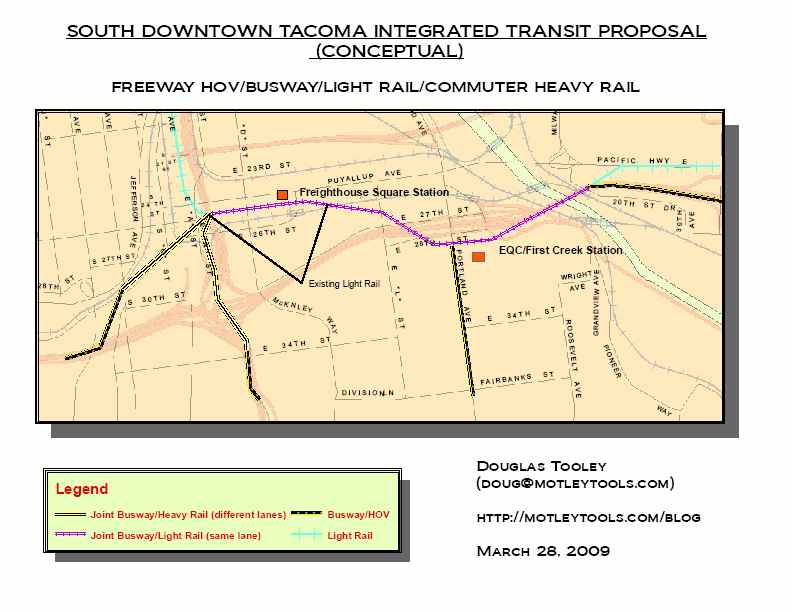
The current southern terminus for the Sounder is at a funky little development called Freighthouse Square – comparable to Crossroads in Bellevue, or perhaps the old Fifth Street Public Market in Eugene. It is a ‘3rd place’ not a mall, built in the old rail freight depot for Tacoma. It’s in the Dome District, (we didn’t tear ours down), just at the Southern end of the Foss Waterway. It’s a funky mixture of old industrial and new retail and commercial now just coming into its own . It’s future seems to be comparable to that of the Pearl District in Portland, much like what has been attempted in the SODO area of Seattle, that somehow has never quite been realized, for some reason.

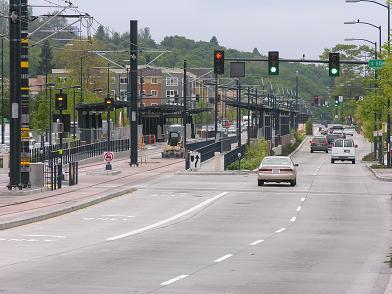
The Dome District has also seen quite a bit of public money lately, mostly transit related. Freighthouse Square is the Sounder station, and across the street is a (6 story) park and ride serving a local and regional bus hub. The Tacoma Light Rail, currently the only functioning element of Sound Transit’s Link project, starts between these two buildings, running north through Downtown to near 6th Avenue in the Theatre District.

The Sounder is planned to continue south to Lakewood – but the crossing of Pacific Avenue has become a major design issue. The small and medium sized businesses of the Dome District felt overlooked, if not bullied, by Sound Transit in this issue, the first ‘appearance’ of that ‘organization’ since their November Prop. 1 defeat. The question seems to have been resolved with the leadership of the Tacoma City Council. The ‘solution’ though has required the relocation of Tacoma’s oldest business, the Star Ice Company.

The first Tacoma residents I met were actually Sound Transit officials – perhaps most notably former City Councilmember Paul Miller and current State Commissioner of Public Lands Doug Southerland. Pacific Avenue, Highway 7, was however my first exposure to Tacoma. Looking at a map highway 7 looks to be the best way to get to the southern entrance and the Paradise area. One however is quickly disillusioned –seeking the solace of green one only finds hundreds of blocks of stop lights and commercial development of varying levels of upkeep – comparable to Hwy 99 north or south of Seattle.

Pacific Avenue as it leaves Downtown Tacoma is no exception. The road is slow and most of the businesses aren’t driver oriented. Currently the best route from the Dome District, and Downtown, is via McKinley Avenue, an I-5 overpass right next to the Tacoma Dome. McKinley Avenue climbs up McKinley Hill to its small neighborhood business district, itself just starting to revitalize, also home to Tacoma’s only dog park. Two dog park regulars have started that areas first coffeeshop, opening any day now. Although health regulations prohibit a dog friendly coffee hangout, the opening of this neighborhood coffeeshop is anticipated by many.

Just to the West , across Pacific, is my neighborhood, Lincoln, also home to the High School of the same name. The two neighborhoods make up what I’ve been calling ‘Presidents Ridge’ – a great area just above Downtown Tacoma with the potential to be a Ballard with a view, er, Admiral District. 34th Avenue is the small arterial connecting these areas and it makes a great view walk of about a mile or so, one way. There are two historic bridges over beautiful ravines in this area. The head of one of these has just been sold by the City of Tacoma to a Downtown Developer, Prium.

This Pacific Prium project has many in the neighborhoods of the South End concerned. Although District City Councilman Rick Talbert claims the housing to be developed will be for ‘firefighters and teachers’ the enabling council resolution which authorized the sale agreement is written to specifically suggest it is replacement housing for the very low income residents of the downtown’s Winthrop hotel. Somebody is lying to someone here, and I feel a bit guilty hoping that it is the housing activists, and not the neighborhoods.

The impact of 100-200 units of affordable housing raises the spectre of the blighted housing project, whatever the subsidized income level. Our neighborhood fears that this may mean downtown is looking at the South End not for revitalization, but as a ‘redlined’ neighborhood to milk as a low-income cash cow. Lincoln High School currently is gang free and we’d like to keep it that way – understanding that the risks of breeding gangs in newer style housing developments is less, it has also not been completely eliminated. The wisdom of placing younger children across the street from the County drunk tank and the methadone clinic also seems a bit unwise.

Most likely the answer will be determined by market forces – Prium is a local developer of high standing but they are having their own housing related financial problems right now – converting one condo project to rentals after failing to sell a single unit at their targeted price. Market savvy folks are betting that the results will depend on how much of a bailout Prium needs – not a bad financial hedge for a good company, all else being kosher.

Personally, I’m hoping for a mix of private and subsidized housing. Seattle is currently discussing the provision of density subsidies in exchange for the inclusion of affordable units – a good strategy. Central to this debate is the question of just how much of a mix can work. Though not directly applicable the desired mix in a privately funded project should also apply to a publically funded one. The maximum any city is doing in this generation of project is 35% - total, moderate income and for the very low.

Perhaps more potential is brewing in the next ravine to the east in that Dome Greenbelt. This is the route by which Hwy 705 climbs to reach Hwy 7 when you are heading South. It is also the alignment for a rail corridor owned by Tacoma Rail which stretches all the way to Elbe via Eatonville.

Just two weeks ago an Interior Department funded multi-jurisdictional study (Norm Dicks is currently chair of the Interior Committee) was released regarding the use of this corridor for Rail/Trail purposes. Unlike King County’s Eastside rail line this multiple use is being seriously, and professionally, studied – NOT decided by dysfunctional partisan political considerations.

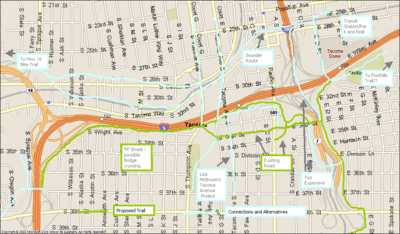
Personally I’ve found that idea to be very timely – as I’ve been talking up the idea of a trail as well – not for the rail corridor, but for the Dome Greenbelt – built just above the I-5 soundwall, like the one on Seattle’s Capitol Hill (the BEST place to watch Fourth of July Fireworks shows). We’ll see if the kismet works, I hope you don’t mind the personal plug.

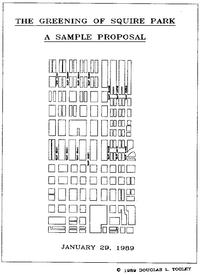
This trail would stretch all the way from the existing trail in McKinley Park to the pedestrian bridge at 38th, near the Tacoma Mall. That western end is the Whitman neighborhood, named after the Walla Walla poet. The proposal is articulated graphically here.

Pat McGregor is the President of the Whitman neighbors, a teacher at Puyallup’s Leschi school. He is perhaps the South End’s most effective leader – largely responsible for the expansion of Downtown’s ‘Alcohol Impact Area’ , scheduled for January adoption. Removing fortified products from store shelves isn’t the cure for all of alcohol’s ills, but it does seem to have some effect – as in Pioneer Square and elsewhere.

Our area certainly has customers for fortified alcoholic drinks – our freeway greenspaces have become homes for the homeless – in one case a nearby encampment was probably well over 100 individuals. These ‘customers’, along with the stereotypical meth addict scravenger regularly use our alleys as travel routes. Thankfully public safety is one issue that everyone agrees on, and efforts in this regard are just starting to build the foundations of solid neighborhood organizations.

Tacoma is building itself a new reputation these days – lets hope it becomes a City where folks who work hard can get ahead – and where everyone can afford a downtown condo once the kids leave. There are risks that the parasites who feed off the poor will attempt to expand their presence here, but I am optimistic. All life is risk, and preserving the history of a City like Tacoma is, in my opinion, a good bet.

Tacoma was once the business center for the State. The history, as I understand was that Tacoma received the first rail line, Everett the second – they joined up in Seattle, which, perhaps due the benefits of competition, became the number one City.

The current word for Tacoma is ‘gritty’. Like the nation’s second City, Chicago, Tacoma is a city of people who work for a living, who earn it. The ridge of the south end may well become the geographical ‘broad shoulders’ of the City – after all a ‘good’ economy is one that benefits everyone, no?
January 25, 2008

Is it okay to lie to protect the First Ammendment?

I'vr got a pet peeve about current elections regulations in Washington State - I thought I might be the only one, but Dori Monson, a talk show host on the top-rated centrist radio station KIRO 710, covered the subject yesterday, or at least got close to it. (Dori is the centrist station's right winger, though he claims to be more of a Libertarian.)

As you know Washington regulations concerning primaries have been the subject of recent Supreme Court Decisions and Initiatives - currently you are required to be a member of a party to participate in the primary decision. I have no problem with that, but as is usual with bureaucracy the devil is in the details.

The problem is this - County Auditors (except King County, go figure) are required to throw out any vote which is independent - either by a cross-over vote between parties or from one choosing not to identify. It's codified in 29A.52.151.

My initial thought that was this must have been some sort of administrative mis-step - perhaps with some degree of intentionality - I did a public records request to State Secretary Sam Reed's office on the subject. I found out I was wrong - one of the female people I correspondend with was kind of insulting and/or threatening when I made the insinuation that the First Ammendment would require tabulating of my vote - regardless if the parties used it or not.

FWIW, I'm a tad disappointed that Reed hasn't already sought to correct what may have been a constitutional oversight - his failure to act does go to his performance in that office. He does seem otherwise capable in his duties and I did vote for him last time around, even though I lean a shade left. I'm still researching the orignal bill that made these modifications but I do gather that Mary Margaret Haugen, someone I respected previously, but has had some suspect actions this year - including apparently supporting the powers that be around the Port of Seattle.

Go Figure.

The Monson/Reed interview, live, is at the start of this audio. Caller comments follow. The only other published reference on the subject that I'm aware of was cited by Dori on his page, from the Whidbey paper.

If your interest in this is great enough to want to see the emails from my PDC request I'd look forward to meeting you, as well as responding to your request.

Oh yeah, the lie thing - which Monson went into - you have to make an oath of party affiliation to vote in a primary. My point is that you should be able to vote independent or cross over in a single race and have the vote reported, but not applied to the Party decision. As it stands for the Presidential Race I think I'm gonna participate in the Republican Caucus and also vote in the completely non-counting Democratic Primary on the 19th.

This law needs to be repealed - it shouldn't require a court case or a big political battle. It is the constitution, arguably the most important part of it - all it should take is a single person pointing out the problem, nothing more - or less.

While you are at it - a suggestion - how about creating primary rules for independents whereby anyone can vote for them - independent or crossover - and allow them to advance if they receive one of the top two positions?

Heyo!

January 26, 2008

Some Thoughts on Marriage 'Law'

Family law is a subject that makes the press regularly these days - it may be gay marriage, domestic violence, or even tax policy. Here, I will argue that perhaps the 'law' does not belong in family situations at all.

I'll illustrate this position by going a bit to the extreme - the answer, which I don't have - is somewhere in the middle. The only thing I will claim is that the current system is broken and to have a sense of the direction in which we should head. Even that direction is subject to debate - something I would consider a success I was to spark such here.

The law as it applies to families is broken. Law makes more problems than it solves in this arena. One could make the case that this is intentional. I will not do that here, but will note that the same question could also be asked in felony arenas as well. Certainly though there have been cases where misapplied family law has actually sparked felonies. These are tragedies to prevent, not merely falling back on a procedure by which the legal system can claim to avoid responsibility.

I believe that the debate over gay marriange and/or civil unions shows us the way to the solution. Marriage is not a matter for the State and the Law to regulate - it is a matter of religious preference and Churches should have the 'authority' over this societal institution.

Religion is a matter of choice - that choice might be a very traditional Catholic, Jewish, or Native American institution. The church choice though could also be something innovative - fo example, a gay embracing offshoot of an established religion, or even something born anew - say the 'Church of Spouse Swappers' - if that was what 'you' wanted.

There are some issues which should be guaranteed by the State - dissolution from a documented abusive relationship would be one, support for a non-working spouse should be another. The rights of 'civil unions' as negotiated by gay activists are probably pretty close to what heterosexual couples deserve as well. No more, no less.

The issue of children in marriage is another area of State involvement - perhaps no more so neglected than in the area of tax policy, even in homosexual discussions. It is my opinion that there are some tax benefits accruing to couples which are, in part, justified on the assumption that Children are present. I would argue that we should be taxing marrieds, without children, at a higher rate and married, with children, at a lower rate. I'm also dubious about assigning retirement benefits to a non-working spouse when there are no children present in the relationship at that particular time. This, if you will, is a functionally 'progressive' tax position.

The resolution of problem marriages should then fall to the 'authority' of each church - forget restraining orders and the like, but do give the Churches some powers in this area - especially in the area of creating a record of evidence documenting a deteriorating relationship.

I'd also go so far as to give the Churches authority to be insurance providers - divorce insurance would be one product, but I see no reason why Churches couldn't be providers of just about any form of the product. The resulting rates,and actuarial tables, cross tabulated by religion, would be a piece of societally relevant 'economic' information.

Lastly, one potential problem - that of a couple who choose to marry but are of different 'traditional' faiths. That too is a matter for the law, allowing those individuals choices in how to handle the situation - say allowing one spouse to accept the marriage standards of another religion without joining it, per se.

I think the best answer to that potential problem is the idea of pre-nuptial agreements. Church marriages could be considered a standard 'pre-nuptial' aggreement concerning the marriage. Individuals would have the opportunity of drafting their own agreements, including modifications of Church practices, if acceptable to that Church.

Some thoughts on Drug 'Law'

Does the law belong in the 'regulation' of drugs in society?

Anthropologists have studied the question of drug use in a wide variety of societies, including those that utilize psychedelics. The generally accepted wisdom, correct me if I'm wrong or out of date, is that societies who have older individuals as mentors for younger users are generally healthy and avoid many of the problems of drug abuse. The role of the native 'medicine man' is perhaps the easiest way to understand this position, at least from my lay perspective.

Certainly drug use can be a contributing factor in crime. Here in Pierce County the current stereotypical problem is the unemployable meth addict looking for income to support drug use in the mix of his or her life's priorities. Not so long ago, and still with us to some extent, would be the similar, but manifestly different, heroin junkie.

The biggest societal problem in this regard though is alcohol and violent crime. In history the provision of alcohol as a reward to fighting troops provided a benefit to the commander - a more aggressive fighter, once the hangover wore off. (not a bad timing factor in the conduct of battle either) The history of marijuana use during the Vietnam era in this regard probably merits continuing historical review (marijuana probably lowers the fighting ability of soldiers).

The trend towards medical marijuana, including in California, federal efforts opposing not withstanding is, I believe, the way to go. And not just for marijuana, but for every drug, including alcohol. Our society has 'medicine men' - they are called medical doctors and they have extensive scientifically founded training as well as strong requirements for social capability manifested as 'bedside manner'.

My thought is that alcohol purchases should be regulated - via the medical profession. The 'administrative' way to do this is something that we should be doing regardless of medical oversight. If you look at the back of your Washington State driver's license it has a barcode. It is merely a minor software problem to require the scanning of this barcode with any alcohol purchase. The benefit of preventing sales to minors alone would justify this wise implementation of technology.

Privacy protections on this information should be high - standards in this age that need review - especially in light of current abuses, including within the legal profession itself. Judgement in the use of this information should also be high. Laws should not be so strict that a person is prevented from hosting a private party without being called an alcoholic. There is nothing wrong with a determined person being able to find small workarounds as a price of protecting liberty for us all. Those workarounds though will require a social network, and those sorts of networks will develop their other problems as well - another case for a law enforcement professional with good judgement.

The availability of alcohol purchase records will also be a useful tool for the law enforcement investigator in the course of sorting through persons of interest and conflicting statements.

I'd argue that all products with psychological effects be regulated to some extent - including stimulants such as caffeine and relaxants. I'm not going to say those products require a bar code scan or age restrictions but their management in that context is definitely appropriate.

I do think psychedelics should be medically regulated products as well, but their use should be among the most difficult.

In my opinion one of the ways to understand a drug is how often you can use it before problems start to appear. Alcohol can be used relatively frequently by some without major problems, even daily in smaller doses. ( I would argue though that this is medically undesirable.) 1-2 cups of Coffee a day is nothing to be concerned about at all, though that too might have minor medical disadvantages. 'Desirable' alcohol use is probably in the area of 3-4 total drinks per week.

Marijuana on a daily, or even weekly, basis does become a dangerous drug. Airplane pilots are regulated on the use of alcohol for a nearly a day prior to flight, as I recall. I would argue those same time frame constraints be placed on anyone in a position of responsibility. In the case of marijuana a time frame from use to work, such as with a truck driver, should be on the order of a week. (that's a lay guess, not scientific or medical judgement) I'd also guess that desirable use of Marijuana is on the order of once a month or so, though it would probably be okay if that was an annual average whereby use was concentrated during a summer vacation or the like.

Psychedelics should most likely be used the most infrequently - as a guesstimate I'd say once a year, maybe twice. Higher frequency use might be okay, but again in the context of annual use as an average, with these drugs though that should be spread out over the course of a lifetime.

Although the emergence of universal insurance may make this moot, it still merits mention as a part of the current conversation on insurance. Making medical insurance a requirement for any drug 'use', including alcohol, would do much to encourage the purchase of that product among groups that are both higher medical risk and less likely to act prudently. The resulting actuarial tables should be a core part of the drug discussion, as well as violent and property crime statistics resulting from relatively more accurate data. FWIW I'd bet there are a fair amount of problem alcohol users trying to scapegoat the marijuana users for some of there own 'problems'.

Lastly, a personal observation. If I am so lucky to die in bed, doing so being stoned during my last days might well not be a bad way to go. Call that a living will, if you wish.